Buy 75mm Decking Screws That Won’t Rust Outdoors

Why 75mm is the go-to length for most UK decking boards, which coatings and materials genuinely resist corrosion outdoors, and which screws from JALFT are worth buying in 2026.
Most UK garden decks are built with boards between 28mm and 32mm thick. At that thickness, a 75mm screw is the standard specification: it passes cleanly through the board and bites at least 43mm into the joist below, comfortably exceeding the 40mm minimum needed for a structural fix. Pick a shorter screw and you are compromising pull-out resistance. Pick a longer one unnecessarily and you risk driving through a narrow joist or overcomplicating installation on a simple domestic build.
Getting the length right is the easy part. The harder question is which 75mm screw will actually hold up outdoors over five, ten, or fifteen years without corroding through, staining the boards rust-brown, or losing its grip as the fixing degrades. That is where most buying decisions go wrong, and it is what this guide focuses on.
Two 75mm screws can look identical in a photograph and perform completely differently outdoors. One will show surface rust within 18 months; the other will look the same as it did on installation day after a decade. The difference is almost entirely in the corrosion protection — the material grade or coating applied to the steel core. This guide explains exactly what to look for so you make the right call before you buy.
The rule for decking screw length is that the fixing must penetrate the supporting joist by at least twice the board thickness — and in practice, a minimum of 40mm into the joist is the widely accepted structural benchmark across the UK timber trade. For boards in the 28mm to 32mm range, a 75mm screw achieves this comfortably.
A 75mm screw driven through a 28mm board leaves 47mm of shank in the joist — well above the 40mm minimum. Through a 32mm board, the remaining penetration is 43mm, still comfortably within structural tolerance. This is why 75mm is the default stock length for professional decking fixings sold to the UK trade.
For boards under 25mm — typically 19mm or 22mm finished thickness — a 60mm screw is more appropriate. For boards over 35mm, such as thick tropical hardwoods or double-stacked softwood framing, a 100mm screw is the correct call. If you are unsure of your finished board thickness, measure it with callipers rather than relying on the nominal size on the pack, as machined timber frequently comes in slightly under its stated dimension.
- Actual finished board thickness falls between 28mm and 32mm (measure, do not assume)
- Joists are at least 47mm deep to accommodate full screw penetration without breakthrough
- If boards are treated softwood, the 75mm length allows for the slight surface softness from the treatment process without grip being compromised
Steel corrodes when iron in the metal reacts with oxygen and water to form iron oxide — rust. In an outdoor environment in the UK, that reaction is almost always happening: rain, dew, condensation, and the moisture content of the timber itself all provide the water element. The only question is how quickly the corrosion progresses, and that depends entirely on the protection applied to the steel core of the screw.
The most common decking screw sold at the budget end of the UK market is a bright zinc-plated (BZP) screw. These are electroplated with a layer of zinc typically measuring between 5 and 12 microns. That is a fraction of the coating applied by hot-dip galvanising, which produces between 45 and 85 microns of zinc coverage. The thinner the zinc layer, the faster it is consumed by the electrochemical reaction with the environment, and once the zinc is gone, the bare steel underneath corrodes rapidly.
In a standard UK garden with normal rainfall, a bright zinc-plated 75mm screw will typically show visible rust at the head within 12 to 24 months. The rust then weeps across the board surface around the screw head, producing brown staining that cannot be cleaned without abrasion. By the time this is visible on the surface, the shank is already compromised and the structural grip is beginning to reduce.
Pressure-treated softwood uses copper-based preservatives that are corrosive to mild steel and accelerate the failure of low-grade zinc coatings. The treatment is there to protect the timber — but if your screws are not rated for contact with treated wood, the preservative chemistry attacks the coating from inside the board, where you cannot see it happening.
Hardwoods including oak, iroko, ipe, and balau contain tannins — organic compounds that react with iron and zinc to produce reddish-brown or black streaking visible on the board surface. With a stainless steel screw, the passive oxide layer on the surface of the metal prevents this reaction entirely. With a galvanised or coated mild steel screw, the tannin reaction will proceed at a rate determined by the species, the moisture content, and the coating quality. For all tannin-rich hardwoods, stainless steel is the only reliable specification.
Hot-dip galvanising (HDG) involves immersing the screw in a bath of molten zinc, which produces a coating of 45 to 85 microns — five to ten times thicker than electroplated zinc. This is the level of protection required to resist corrosion in a typical UK outdoor environment over a 10 to 15 year service life.
For domestic garden decking built with pressure-treated softwood in an inland location, a quality HDG screw is a practical and cost-effective specification. It is also compatible with the copper-based preservatives used in modern treated timber, provided the zinc coating thickness is adequate — this is why hot-dip galvanised is specified rather than electroplated when working with treated wood.
- Boards are pressure-treated C16 or C24 pine, spruce, or larch
- The garden is inland and not subject to salt air or elevated humidity
- Budget is a consideration and the deck is a standard domestic structure
- You need a reliable fixing that will comfortably outlast a typical 10-year build lifecycle
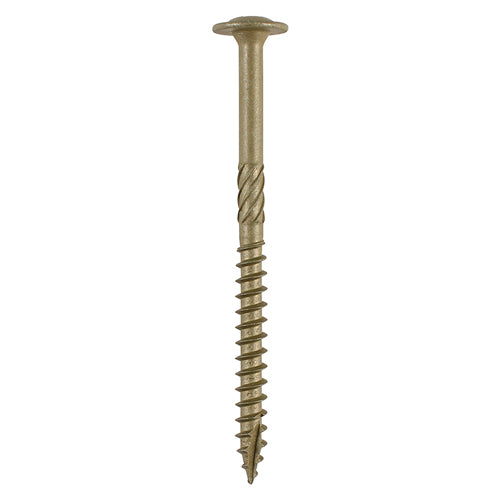
Green-coated exterior screws are specifically engineered for treated softwood and outdoor timber construction. The green coating is a polymer-epoxy or similar organic barrier coating applied over a hardened steel core, providing corrosion resistance compatible with the copper-based preservatives used in modern pressure-treated timber. The coating is rated for Class 4 corrosion resistance under EN ISO 12944 — the specification required for outdoor structural fixings in moderately aggressive environments.
The TIMCO Wafer Head Exterior Green Timber Screw is a well-established example of this category in the UK trade. The wafer head profile sits flush with the board surface without requiring a separate countersink, the Pozi drive provides positive engagement during installation, and the thread geometry is designed for softwood rather than for panel materials, giving the torque characteristics needed to pull a decking board firmly down onto the joist in a single pass.
- Boards are pressure-treated softwood and the deck is being built in a standard UK garden environment
- You want a screw designed specifically for treated timber chemistry rather than a generic galvanised fixing
- You need a clean flush finish without a separate countersink operation on each fixing position
- You are working at volume and need a consistent, reliable fixing that drives cleanly in softwood
Stainless steel screws carry a passive chromium oxide layer on their surface that prevents the iron in the alloy from reacting with oxygen and water in the way mild steel does. Provided the grade is appropriate for the environment, a stainless screw will not rust in any meaningful way over the lifetime of the deck.
A2 (grade 304) is the correct specification for inland gardens with hardwood or softwood decking. A4 (grade 316) adds molybdenum to the alloy, giving it significantly greater resistance to chloride attack, and is the correct specification for coastal locations, poolside decks, and any installation within approximately two miles of the sea. Using A2 in a high-chloride coastal environment risks visible corrosion at the screw head within three to five years — the salt chlorides penetrate the passive layer that gives standard stainless its protection.
| Coating / Material | Zinc thickness | Best board type | Typical lifespan | Avoid when |
|---|---|---|---|---|
| Bright Zinc Plated (BZP) | 5 to 12 microns | Indoor joinery only | 1 to 3 years outdoors | Any outdoor application |
| Green Exterior Coated | Polymer barrier coating | Pressure-treated softwood | 10 to 15 years | Hardwood, coastal sites |
| Hot-Dip Galvanised | 45 to 85 microns | Treated softwood, inland | 10 to 15 years | Hardwood, coastal sites |
| A2 Stainless Steel | Not applicable | Softwood and hardwood, inland | 25 years or more | Coastal (use A4 instead) |
| A4 Stainless Steel | Not applicable | All timber types, all locations | 25 years or more | No UK outdoor exclusions |
Choosing the right coating is only part of the specification. The thread design, shank profile, and head type of the screw also need to suit the timber being fixed. A screw engineered for softwood will drive smoothly through pine but may cam out, strip, or split a dense hardwood board if no pilot hole is used.
Pressure-treated pine and spruce in C16 and C24 grades are the backbone of UK domestic decking. At 28mm to 32mm finished thickness, these boards work well with a twin-thread 75mm green exterior or hot-dip galvanised screw. The thread geometry found on purpose-built decking screws cuts through the softwood fibres cleanly rather than pushing them aside, reducing the risk of splitting when driving close to board ends.
Pilot holes are optional for most mid-board fixing positions on softwood under 30mm thickness, but they are recommended at board ends where the grain is end-on and splitting risk is at its highest. Use a 2.5mm to 3mm pilot drill for a 4.5mm shank screw, and keep fixing positions at least 20mm from board ends as a minimum margin.
Hardwood species are denser and harder than softwood by a considerable margin. Ipe — one of the most popular tropical decking timbers in the UK — has a density around 1,000 kg per cubic metre, compared to roughly 500 kg per cubic metre for pine. At that density, attempting to drive a screw without pre-drilling will split the board, shear the screw shank, or strip the drive head before the screw is fully seated.
Pilot drilling is mandatory for hardwood at every fixing position, not just at board ends. Use a pilot drill sized at approximately 70 to 75 percent of the screw shank diameter — for a 4.5mm shank, that means a 3mm to 3.5mm drill. A countersink bit is equally important: hardwoods will not compress around the screw head as softwood does, and without a countersink the head will sit proud of the surface, creating a trip hazard as well as a water trap at the board edge.
- Mark the fixing position at least 20mm from the board end
- Drill a 3mm to 3.5mm pilot hole through the board and 20mm into the joist
- Follow with a countersink bit to recess the head 1 to 2mm below the surface
- Drive the A2 or A4 stainless 75mm screw at a controlled speed — do not overdrive
- Check the head is flush to 2mm below the surface before moving to the next position
Oak, iroko, ipe, and balau contain tannins that react chemically with zinc and iron. Using a galvanised or green-coated screw in these timbers will produce dark staining around each fixing point within the first wet season, and the screw itself will corrode at an accelerated rate from the inside out. The staining cannot be cleaned without sanding the board surface. Only stainless steel prevents this reaction.
The most common installation error with decking screws is driving at maximum speed into dense or treated timber. High driver speed combined with inadequate pilot drilling generates heat that can soften the coating at the head, making it more susceptible to early corrosion from the point where the drive engages. It also dramatically increases the risk of cam-out — the driver bit slipping out of the head under high torque and gouging the board surface.
Set your impact driver or drill driver to a medium torque setting and reduce speed for the final turn as the head approaches the board surface. The goal is a head that sits flush to 2mm below the surface with a clean, undamaged drive recess. A damaged drive recess is not just cosmetic: it creates a corrosion entry point where the coating has been breached and bare steel is exposed to the elements.
For boards up to 120mm wide, one screw per board per joist is the standard fixing pattern. For boards over 120mm wide, two fixings per joist are needed to resist cupping — the tendency for wide boards to curve across their width as moisture content changes seasonally. A board fixed at only one point per joist will cup visibly within a season or two, creating a tripping hazard and allowing standing water to collect in the concave surface.
The standard joist spacing for a UK domestic deck is 400mm centres, sometimes 450mm for lighter loads. At 400mm centres with a standard 120mm board width, the approximate quantity of 75mm screws needed is one per board per joist — which works out to roughly 25 screws per square metre of deck. Add 10 percent to your calculated quantity for waste, broken fixings, and the occasional repositioning that every installation involves.
If you are fixing treated softwood boards that have been delivered wet or damp, leave them to acclimatise for at least 48 hours before laying. Boards fixed at high moisture content will shrink as they dry, potentially pulling away from fixings and leaving visible gaps. For the same reason, fix boards with a 5mm to 6mm gap between them to allow for seasonal moisture movement without boards pressing against each other and lifting.
- Finished board thickness confirmed as 28 to 32mm (measured with callipers)
- Screw coating selected to match timber type and location (green/HDG for softwood, stainless for hardwood or coast)
- Quantity calculated at 25 screws per m2 plus 10 percent waste allowance
- Correct drive bit type and size confirmed and available on site
- Pilot drill available (2.5 to 3mm) for board-end fixing positions
- Minimum 20mm end distance marked on all boards before first screw
- Driver set to medium torque, speed reduced for final seating
- Screw heads checked flush to 2mm below surface on first row before proceeding
- 3mm to 3.5mm pilot drill used at every fixing position
- Countersink bit used at every position before driving
- A2 or A4 stainless steel screws confirmed — no galvanised or coated steel
- Screw head seated 1 to 2mm below surface and drive recess undamaged


Shop 75mm Decking Screws at JALFT
UK stock ready to despatch. The TIMCO Wafer Head Exterior Green range and the full decking screws collection are all available with next-day delivery options and trade account pricing for regular buyers.


