Decking Screws Buying Guide 2026

Screw length, material, coating, head type, timber versus composite compatibility, and the most common installation mistakes — everything in one place before you build or specify.
Decking screws are one of those components that homeowners routinely underspecify. The boards get chosen carefully, the frame gets measured twice, and then a box of cheap screws from a builder's merchant gets thrown in as an afterthought. Within two seasons, those screws are corroding, the board heads are stripping, and the deck is creaking with every step.
The right decking screw is determined by four factors: the length you need to penetrate the joist adequately, the material and coating that will survive your specific outdoor environment, the head geometry that suits your board type, and whether your decking is solid timber or composite. This guide covers every decision point, with specific guidance for both new builds and replacement work.
Most decking screw failures in UK gardens are not caused by the wrong length or head type — they are caused by the wrong corrosion protection. A zinc-plated screw will begin to rust visibly within 12 to 24 months in a typical UK outdoor environment. Hardwoods accelerate this further. The extra cost of a properly coated or stainless-steel screw is always recovered in longevity.
Screw length is determined by the thickness of the decking board and the depth of joist penetration required. The standard rule is that the screw must penetrate the joist by at least twice the thickness of the board — in practice, a minimum joist penetration of 40mm is widely recommended for structural reliability. For most UK decking installations, this produces the following length requirements.
Always measure the actual board thickness before ordering. Board thicknesses are nominal — a "32mm" board may machine to 30mm or 31mm finished. Use a pair of callipers or a digital gauge rather than relying on the label. Order screws once you have confirmed the finished thickness, not the nominal size.
On any elevated or load-bearing deck, inadequate joist penetration is a structural risk. If your screw does not reach a minimum 40mm into the joist, the board can lift during expansion cycles, particularly with hardwoods that move significantly with moisture. In elevated structures, the consequence of a loose board is a trip or fall hazard. When in doubt, go up a length.
Stainless steel decking screws offer corrosion resistance that no coating can fully replicate over a 15 to 25-year product lifespan. The two grades relevant to UK outdoor use are A2 (304 stainless) and A4 (316 stainless). A2 is suitable for most inland UK gardens. A4 is the correct specification for coastal locations, marine environments, and any deck within roughly two miles of the sea, where airborne chloride levels accelerate oxidisation.
Stainless steel is also the mandatory choice for most hardwood decking. Species such as ipe, balau, iroko, and oak contain tannins and oils that react chemically with mild steel and low-grade zinc coatings, producing rust streaks that leach across the board surface within months. With stainless steel, this reaction does not occur.
- Your deck is constructed from hardwood (ipe, balau, oak, iroko, cumaru)
- The installation is within two miles of the coast or in a high-humidity environment
- You want a fixing that will outlast the boards themselves without remedial work
- You are specifying a commercial, elevated, or public-access deck where longevity is a contractual requirement
Hot-dip galvanised screws are coated in a thick layer of zinc by immersion in molten zinc, giving a coating thickness typically between 45 and 85 microns. This far exceeds the thin electroplated zinc coating found on cheaper bright zinc-plated screws, which typically runs to only 5 to 12 microns and is inadequate for outdoor structural use in the UK.
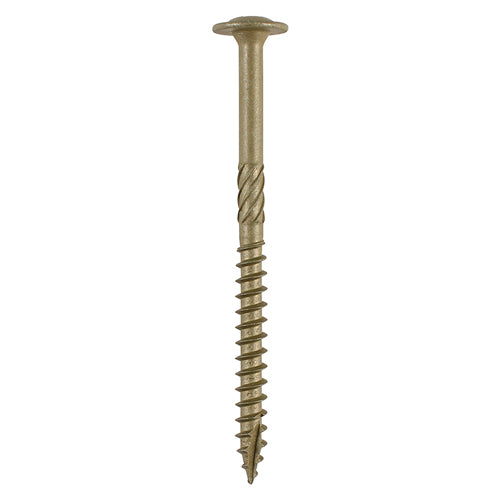
For pressure-treated softwood decking on a domestic garden deck in an inland location, a quality hot-dip galvanised screw is a practical and cost-effective choice. It should not be used with hardwood decking, as the tannin reaction remains a risk, nor in coastal environments where the zinc layer degrades more rapidly.
- Your boards are pressure-treated softwood (C16, C24 treated pine or spruce)
- The location is inland and not subject to salt air or extreme humidity
- Budget is a consideration and the deck is not a permanent or commercial structure
- You are replacing existing galvanised fixings on a like-for-like basis
Many composite decking manufacturers specify their own branded or proprietary polymer-coated screws. These screws typically combine a hardened steel core with a multi-layer polymer or epoxy coating, giving them the corrosion resistance needed for composite board materials while producing a clean, countersunk finish that sits flush with the board surface. The Torx (star-drive) head is standard on most composite-specific screws, as it eliminates cam-out during driving and allows the torque required to seat the screw cleanly in the harder composite material.
Some composite systems also offer hidden fixing clips that eliminate visible screw heads entirely. However, hidden clips are only suitable for grooved composite profiles and cannot be retrofitted to boards already laid. If you are working with a solid-profile composite board, a compatible coated screw is the correct fixing.
- Your decking is composite and the manufacturer specifies a particular screw type or brand
- You require a colour-matched or low-visibility finish on a solid composite profile
- You are working with a dense composite material that requires a self-drilling tip to prevent surface cracking
- Warranty preservation is a consideration for a newly installed composite deck
| Screw type | Corrosion resistance | Best application | Typical lifespan | Cost per 100 |
|---|---|---|---|---|
| A2 Stainless Steel | Excellent (inland) | Hardwood, premium softwood | 25+ years | £12–£22 |
| A4 Stainless Steel | Excellent (coastal) | Coastal and marine builds | 25+ years | £18–£28 |
| Hot-Dip Galvanised | Good (inland) | Pressure-treated softwood | 10–15 years | £6–£14 |
| Polymer-Coated | Good to very good | Composite decking | 10–20 years | £10–£22 |
| Bright Zinc-Plated | Poor | Not recommended outdoors | 1–3 years | £3–£6 |
Once you have determined the correct length and material, head geometry and thread design control how the screw installs and how it performs over time. The wrong combination produces stripped heads, split boards, and screws that work loose as the wood cycles through wet and dry seasons.
A countersunk head has a flat underside taper that pulls the screw flush with or just below the board surface, leaving a clean recess. This is the standard for timber decking and works well with pre-drilled pilot holes. A bugle head (the flared, concave underside profile) distributes load more gradually as it seats, making it better suited to composite boards where a sharper countersunk edge can cause surface stress cracking. Most composite-specific screws use a bugle or modified bugle head for this reason.
Self-countersinking screws — which have a serrated or ribbed underside that mills out a recess as the screw drives home — remove the need for a separate countersink bit. They are useful for high-volume work but require more torque and can cause surface damage in very dense hardwoods if the driver speed is too high.
Torx (also written as TX or star drive) is now the standard drive for professional decking screws in the UK because it virtually eliminates cam-out — the slipping of the bit out of the drive under torque that causes head damage and is a significant problem with Pozi and cross-head drives. Torx T20 is standard for 4.5mm decking screws; T25 is used for larger or heavier fixings. All professional decking screw packs should include compatible Torx bits, but always confirm the bit size before starting work.
Pozi drive is still found on budget decking screws and remains adequate for softwood in moderate volumes. Square (Robertson) drive is popular in North American decking products imported to the UK. Both are acceptable; neither offers the cam-out resistance of Torx for sustained driving into hardwood or composite.
- Torx T20 or T25: first choice for all professional and high-volume decking work
- Pozi PZ2: acceptable for softwood in domestic quantities with a quality driver bit
- Square drive: check bit compatibility before purchasing if using imported composite systems
- Cross-head (Phillips): not recommended — high cam-out risk, avoid for structural fixings
Full-thread decking screws provide higher pull-out resistance throughout the length of the screw. Twin-thread (or double-helix) screws drive faster and leave a cleaner hole because they remove more material per revolution. For most domestic softwood decking, a quality twin-thread screw is the practical choice. For hardwood, a single or reduced-thread shank under the head is important: if the thread engages in both the board and the joist simultaneously, it can compress the board upward rather than pulling it down, leaving a proud fit or causing splitting around the head.
The shank design also matters on hardwood. A smooth shank directly beneath the head — sometimes called a smooth-shank or Type 17 tip design — allows the board to be drawn tightly to the joist without compression resistance from the thread above. This is why hardwood-specific decking screws differ from general-purpose screws, even of the same gauge and length.
Timber decking covers a wide range of species and treatments, from basic pressure-treated C16 pine through to premium tropical hardwoods. The specification requirements differ significantly between them, and using a screw designed for softwood in a hardwood installation is one of the most common causes of on-site problems.
Pressure-treated softwood is the backbone of UK domestic decking. C16 and C24 grade treated pine boards, typically 19mm to 32mm thick, are widely available and respond well to a properly specified decking screw. The treatment chemicals used in modern pressure-treated timber (primarily copper-based preservatives since the industry moved away from CCA) are reactive with mild steel. A hot-dip galvanised screw with a minimum 45-micron coating is the lowest acceptable specification for treated softwood; stainless steel is preferable for longevity.
Pilot drilling is optional on softwood below 25mm thickness but strongly recommended at board ends, where splitting is most likely. Use a 2.5mm to 3mm pilot drill for most 4.5mm shank decking screws. Always countersink to allow the head to sit flush without surface fibres tearing around the recess.
Hardwood decking demands a different approach at every stage. The density of species such as ipe (around 1,000 kg/m3) and balau means that driving a screw without a pilot hole will split the board, strip the drive head, or shear the screw shank. Pilot drilling is mandatory, not optional. Use a pilot drill sized at approximately 70 to 75 percent of the screw shank diameter — typically 3mm to 3.5mm for a 4.5mm screw.
A countersink bit is equally important: hardwoods do not compress around a screw head the way softwood does. Without a countersink, the head will stand proud and create a trip hazard as well as an entry point for water. The countersink depth should allow the head to sit 1 to 2mm below the surface, preventing water pooling at the recess.
Composite decking is a fundamentally different material to timber and requires a different approach to fixings. Composite boards are typically denser and harder than softwood, more dimensionally stable than timber, and produced to tighter tolerances — but they are also more sensitive to cracking at fixing points and more likely to show surface damage if an incompatible screw type is used.
Solid composite decking boards — those without a grooved edge profile for clip-fixing — must be fixed from the face with a compatible screw. The key specifications for a composite surface-fix screw are a self-drilling or Type 17 tip (which cuts rather than pushes through the composite material), a bugle or modified countersunk head to distribute seating load and reduce cracking, and a coating that does not react with the PVC or wood polymer composite material.
Most composite board manufacturers specify Torx drive and a colour-matched or low-profile coated screw. Some specify their own proprietary branded screw and will only honour board warranties where those screws are used. Before purchasing fixings for a composite deck, read the board manufacturer's installation guide and confirm fixing requirements. This one step avoids the most common composite warranty dispute.
Grooved composite boards can be fixed using a hidden clip system, where plastic or stainless steel clips slot into the groove on each board edge and are screwed down to the joist before the next board is fitted. The clip holds the board laterally whilst allowing for the slight longitudinal movement that composite boards undergo with temperature change. The result is a completely screw-free surface with consistent 5mm to 6mm spacing between boards.
Hidden clips require compatible groove profiles, correct joist spacing (typically 400mm centres, though this varies by manufacturer), and a specific clip screw — usually a short 35mm to 40mm Torx-drive fixing supplied with the clip pack. If you are considering a grooved composite system, confirm joist spacing requirements before the frame is constructed, as retrofitting a hidden clip system to an incorrectly spaced frame is not possible without rebuilding the substructure.
Most decking screw failures are predictable and preventable. The following problems account for the vast majority of callbacks and remedial work on UK decking installations.
Visible screw rust and associated brown staining across board surfaces is almost always caused by using a bright zinc-plated or low-grade electroplated screw in an outdoor environment. The thin zinc layer, typically under 12 microns, is insufficient for prolonged outdoor exposure in the UK climate and fails within one to two seasons. Once the base steel is exposed, it corrodes rapidly, and the rust weeps across the board surface around the screw head.
The solution is always specification rather than remediation — there is no effective way to treat rusted screws in situ without removing the boards. Specify hot-dip galvanised as a minimum for softwood, stainless steel for hardwood and coastal use, and polymer-coated fixings per manufacturer's guidance for composite boards.
Splitting occurs when a screw is driven too close to the board end, when no pilot hole is used in hardwood, or when an oversized screw gauge is chosen relative to the board thickness. The minimum end distance for a decking screw is generally three times the screw shank diameter — for a 4.5mm screw, this is a minimum of 13.5mm from the board end, though in practice 20mm is a safer margin.
In hardwood, always pilot drill every fixing position, not just at ends. In softwood, pilot drilling at board ends is essential; central fixing points can often be driven without a pilot hole in boards under 25mm thickness if a sharp, quality screw is used and the driver speed is controlled.
Loose screws after one or two seasons are typically caused by insufficient joist penetration (under 40mm), a full-thread screw used in hardwood where the thread compresses rather than pulls the board down, or repeated expansion and contraction of the board without sufficient fixings per board to resist the movement forces. Softwood boards below 120mm width should have one screw per joist per board; boards above 120mm typically require two fixings per joist to prevent cupping.
If screws are working loose in an existing deck and the boards cannot be lifted, a proprietary epoxy anchor compound injected into the screw hole before re-driving can temporarily restore grip, but this is a remedial measure rather than a permanent fix. The correct approach is to lift affected boards, drill new pilot positions offset from the failed holes, and re-fix with correctly specified screws.


- Actual board thickness measured with callipers (not nominal size)
- Joist penetration of at least 40mm confirmed from the chosen length
- Longer length selected for elevated or load-bearing deck structures
- A2 or A4 stainless steel specified for any hardwood decking board
- A4 stainless selected if location is coastal or within two miles of the sea
- Hot-dip galvanised confirmed as minimum for pressure-treated softwood
- Composite manufacturer's screw specification checked before ordering
- Bright zinc-plated screws eliminated from consideration for outdoor use
- Torx T20 or T25 drive selected for professional or high-volume work
- Bugle or self-drilling head confirmed for composite boards
- Smooth shank below head selected for hardwood installations
- Compatible drive bit included or confirmed before work begins
- Pilot drill bit sized at 70 to 75 percent of screw shank diameter
- Countersink bit available for all hardwood and composite installations
- Minimum 20mm end distance from board ends confirmed
- Two fixings per board per joist specified for boards over 120mm width
Shop Decking Screws at JALFT
UK stock, next-day delivery available, and trade accounts with volume pricing. All fixings supplied with full technical specifications and material certifications.


